Saving America's Story
Is it Columbus Day or Indigenous Peoples Day? Charlatan follows the new American identity.
18 October 2026
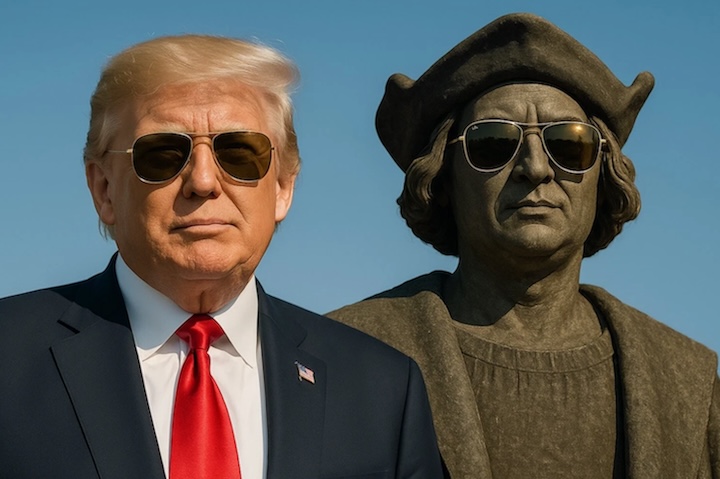
Was it Columbus Day (a U.S. federal holiday honoring Christopher Columbus), or Indigenous Peoples Day (a 2021 U.S. presidential proclamation instructing the nation to honor its Native Americans)? On the second Monday in October, Americans can choose between an Italian explorer sailing for the Spanish crown and the courage and culture of the very people he displaced and conquered in America.
Recall protesters toppling Baltimore’s Christopher Columbus statue near Little Italy and throwing its broken pieces into the Inner Harbor during demonstrations following George Floyd’s death. Five years on, President Donald Trump accused Democrats via Truth Social of doing “everything possible to destroy Christopher Columbus,” and vowed to bring Columbus Day “back from the ashes.” A 13-foot replica was installed on the White House grounds in 2026.
As the National Park Service completed an $11.8 million restoration of the Christopher Columbus Memorial Fountain at Union Station, President Trump reminded the nation of “a vicious and merciless campaign to erase our history.” Seventeen states and the District of Columbia now recognize Indigenous Peoples’ Day or a comparable Native American holiday on the second Monday in October, even as Columbus Day remains a federal holiday in what has become a paradox of public policy.
A predominant population in 1492, today Indigenous Peoples are still stumping for their rights, tribal lands, and sovereignty. At the core of this debate lies derision, and for each of us, a decision about which stories to tell our children. The fight over a holiday has become a fight over American identity itself:
Who wrote the founding story, and who gets to keep telling it?
Less than four weeks before the November 3 midterms, Trump gathered several hundred Italian Americans in the East Room and explained “the radical left communists hate Columbus.” The same day, a House bill was introduced to cut off federal funds to any state or city that celebrates Indigenous Peoples Day instead of Columbus Day. Democrats have their own bill, the Indigenous Peoples’ Day Act, which would strike Columbus Day from federal law altogether. Neither has come to a vote. Meanwhile, at least 355 Native American and Indigenous candidates ran or are running for local, state and federal office in 2026. It is the strongest showing of Native American political candidates in American history.
With Democrats increasingly favored to regain control of the House of Representatives, the approaching midterms promise a change in congressional power, if not necessarily a change in the country's political predicament.
Scholarly estimates of the Native population north of present-day Mexico in 1492 range from 2 to 18 million. By 1900, the U.S. Census counted about 237,000. Today, nearly 4 million Americans identify as American Indian or Alaska Native alone, and 9.7 million alone or in combination with another race, according to the 2020 Census. Yet even a century of recovery has not restored what was lost.
How and why they were conquered begins in Spain. In 1492, Spain sent mariner Christopher Columbus to scout, discover and colonize the New World for the Spanish Empire. The gist of which was to exploit their land, natural resources and labor. The National Park Service observes “In the Land of Frozen Fires:”
Conquistador Don Juan de Oñate is granted permission by King Philip II to colonize Santa Fe de Nuevo México in 1595. After Acoma warriors kill a party of Spanish soldiers, including Oñate’s nephew, in December 1598, a three-day assault on the Keres Acoma Nation in January 1599 results in the Acoma Massacre. An estimated 800 Acoma people are killed, including some 500 men and 300 women and children. The aftermath includes sentencing approximately 500 survivors to forced servitude, many for 20 years, and ordering the amputation of one foot from every Acoma man over the age of 25.
From the Age of Discovery onward, catchy phrases such as “Columbus sailed the ocean blue in 1492” somehow romanticized Europe’s arrival in the Americas after which not only Spain but subsequently Portugal, Britain, France, and the Netherlands all began claiming the continent as their own. The next 400 years oversaw the Europeans displace, infect, deprive, enslave, disestablish and exterminate the majority of the Indigenous Peoples of America. Moreover, their policies and practices informed America’s founding fathers.
In 1779, General George Washington, Commander-in-Chief of the Continental Army, gave orders to destroy the crops, villages and establishments of the Indigenous Peoples. He writes to Major General John Sullivan:
The expedition you are appointed to command is to be directed against the hostile tribes of the six nations of Indians, with their associates and adherents. The immediate objects are the total destruction and devastation of their settlements and the capture of as many prisoners of every age and sex as possible. It will be essential to ruin their crops now in the ground and prevent their planting more.
Fifty years on, President Andrew Jackson signed the Indian Removal Act: forcibly removing 60,000 Indigenous Peoples from their villages; incarcerating them in stockades; and forcing them to walk more than 1,000 miles to Indian Reservations. In the Cherokee removal alone, over 4,000 died, and many are buried in unmarked graves along the Trail of Tears. President Andrew Jackson writes:
By persuasion and force they have been made to retire from river to river and from mountain to mountain, until some of the tribes have become extinct and others have left but remnants to preserve for a while their once terrible names.
Nearly 200 years on, the United States stands at a crossroads with its Indigenous Peoples. There is a growing recognition of the historical injustices; a growing awareness of the valuable knowledge they hold regarding land management and environmental stewardship; and a desire to acknowledge their rich cultural heritage. Even the Vatican formally “repudiates those concepts that fail to recognize the inherent human rights of indigenous peoples.” Including, but not limited to, the legal and political Doctrine of Discovery.
The U.S. Supreme Court weighed in when it rejected a challenge to the Indian Child Welfare Act. Associate Justice Neil Gorsuch writes in his concurring opinion in Haaland v. Brackeen:
In affirming the constitutionality of the Indian Child Welfare Act (ICWA), the Court safeguards the ability of tribal members to raise their children free from interference by state authorities and other outside parties. In the process, the Court also goes a long way toward restoring the original balance between federal, state, and tribal powers the Constitution envisioned.
The U.S. Land Buy-Back Program for Tribal Nations, a decade-long effort to return fractured land to Tribal ownership, restored nearly 3 million acres in 15 states and paid $1.69 billion to more than 123,000 individual landowners. Congress went further still. In December 2025, after a fight dating to 1888, the Lumbee Tribe of North Carolina won full federal recognition, becoming the nation’s 575th federally recognized tribe and the largest east of the Mississippi River.
Yet what Washington gives with one hand, it takes with the other.
In March 2026, the federal government transferred Oak Flat — Chí’chil Biłdagoteel, land the San Carlos Apache have used for centuries for prayer and ceremony — to Resolution Copper, a venture of two international mining companies whose planned mine tribes say will destroy it.
While the Indigenous Peoples represent a scant 2.9% of the U.S. population today, Native American ancestry reaches well beyond those who identify as Native. A 2014 genetic study of more than 160,000 Americans, published in the American Journal of Human Genetics, found that one in 20 African Americans carries Native American ancestry, and the average Latino genome is 18% Native American.
The National Museum of the American Indian was placed under a “comprehensive internal review” by the Trump administration in 2025. On July 4, 2026, the White House released a 162-page report, “Saving America’s Story,” charging that the Smithsonian portrays the nation’s founding as a “fundamentally oppressive and genocidal effort to take Native Americans’ land.” It singles out the museum’s “Nation to Nation” treaty exhibit, objecting to an introductory video describing “the rise of a new great nation at the sacrifice of hundreds of others.”
When a government decides which history its museums may tell, America’s Indigenous Peoples know the pattern better than anyone: they were the first to be written out. President Harry Truman warns Congress in 1950:
Once a government is committed to the principle of silencing the voice of opposition, it has only one way to go, and that is down the path of increasingly repressive measures, until it becomes a source of terror to all its citizens and creates a country where everyone lives in fear.
When France finally sold the Louisiana Territory, Napoleon Bonaparte is reputed to have said, “To get power you need to display absolute pettiness [demagoguery], but to exercise power you need to show true greatness [liberty, equality, freedom].” Such pettiness and greatness rarely if ever exist in one person.
Author Colin Woodard traces 11 rival regional cultures in the United States today, from the utopian Yankeedom to the conservative Greater Appalachia and Left Coast. Yet before any of them, there was a single moment, first impression, statement of purpose, and life lesson.
Samoset, Plymouth Colony 1621
On March 16, 1621 — Samoset, the Abenaki sagamore who was the first Native American to make peaceful contact with the Pilgrims — startled British colonists by simply walking into Plymouth Colony and greeting them in English with a warm: “Welcome.”