Marriage Equality
The U.S. Supreme Court declares Same-Sex Marriage the new law of the land. Editor in Chief DREW GOWING remembers the controversial march toward Marriage Equality.
By Drew Gowing26 June 2015
Ever since the U.S. Supreme Court pronounced Marriage Equality the new law of the land, the High Court’s landmark decision presented a confounding challenge to a relatively small, once marginalized class. As victories accumulate for the gay community, the institutions of marriage, family, and America as we know it are changing, too.
According to the American Sociological Review, more than 50% of all gay men hold bachelor’s degrees in the 21st century, compared to 35% of their straight counterparts, which, among other things, has produced some savvy tech visionaries and leaders at startups like PayPal, Facebook, and Apple. With their hands on the levers of the Fourth Industrial Revolution, gays like Peter Thiel, Chris Hughes and Tim Cook were promoting an idea whose day and time had come. Create something new rather than compete with a crowded marketplace. A natural stance for men who’d always prided themselves on being different—until Marriage Equality invited them to join the herd mentality.
From Provincetown to Boystown and beyond, drag shows are increasingly filled with bachelorette parties while gays are migrating to the suburbs for their slice of the American pie. The 50th anniversary of the Stonewall Riots, the defining moment for the Gay Rights Revolution, brought 5 million people from around the world to the streets of New York City. Still, some who raced to the altars compliments of Marriage Equality now say they feel a loss amidst the celebrations. The creative grit and determination with which the gay community once confronted discrimination, stigma, and persecution was slipping into mainstream America.
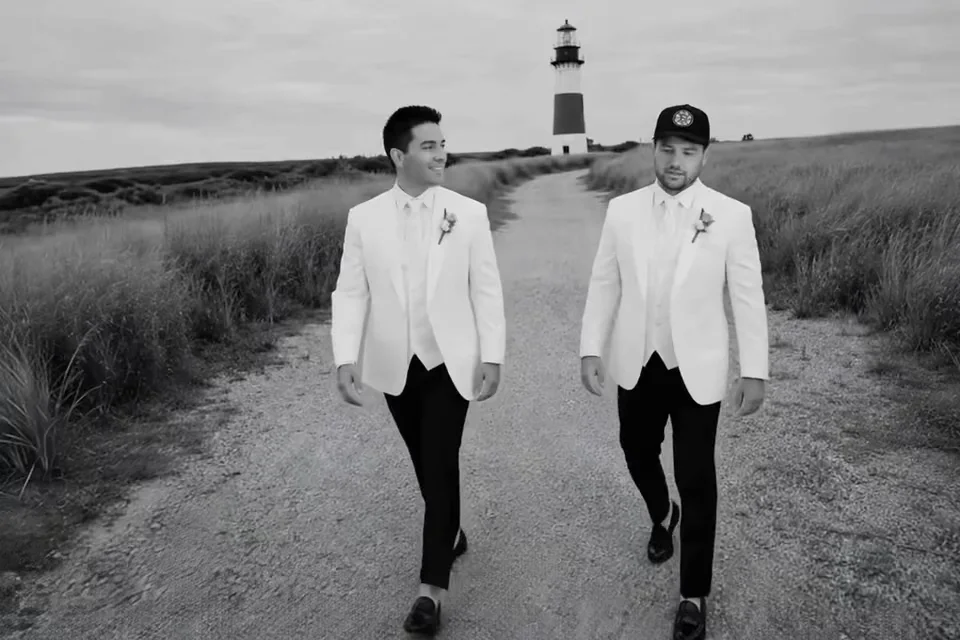
The late Reverend Elizabeth Tarbox, of the Unitarian Universalist Church, began our Commitment Ceremony thus as we stood knee deep in waving grass against the world.
Holy and beautiful the custom which brings us together. To face our ideals, make confessions, offer forgiveness, be strengthened, and celebrate. In this blessed place, in this sacred moment, breathes the worship of ages. So let us be alive to this moment and be joyful.
It was bewitching, the notion, of a single constant attachment, and all that can be said of happiness, revolving entirely around one particular person. But as I declared my love that summer night in 1997, I knew somehow in point-of-fact that love had yet to be tested. For any two fools can snuggle by a fire, but who’ll sit with you through the dark night, too?
Any two fools can snuggle by a fire, but who’ll sit with you through the dark night, too?
We lived by a ‘gentlemen's agreement’ for nearly two decades — a day in time when being gay was considered a sin, a disease, and a crime by every conceivable institution of society. When suddenly, and seemingly randomly, the Supreme Court ruled in 2015 that the U.S. Constitution guarantees the right to same-sex marriage all along. Chief Justice John Roberts dissents in Obergefell v. Hodges:
This Court is not a legislature. Whether same-sex marriage is a good idea should be of no concern to us. Under the Constitution, judges have power to say what the law is, not what it should be. The people who ratified the Constitution authorized courts to exercise 'neither force nor will but merely judgment.'
The 5-4 decision, in fact, had done precisely that when it ruled that state bans on same-sex marriage had run afoul of the Due Process Clause and Equal Protection Clause enshrined in the Fourteenth Amendment of the United States Constitution. By 2026, Marriage Equality is legally performed and recognized by nearly 40 countries around the world.
"No union is more profound than marriage," Justice Anthony M. Kennedy wrote for the majority, "for it embodies the highest ideals of love, fidelity, devotion, sacrifice, and family."
Yet marriage, in the eyes of the law, is merely an institution of property, and legalizing a personal relationship so often comes with a cost. If or when a lawmaker, clergyman, or lawyer intervenes in a marriage, they sometimes interfere with a uniquely personal and evolving relationship and world.
Humans, by nature, are evolutionary creatures, who civilized themselves roughly 6000 years ago through a highly sophisticated discipline called communication. While the species survive, insular cliques, companionships and edge communities thrive not by complying with societal norms but rather by collaborating with each other’s shared circumstance. Laws and statutes set into stone protect consensus, institutions, and countries. While at the same time intruding upon and hindering each couple's right and responsibility to govern their own unique set of circumstances. To wit, over 40% of all first marriages are projected to end in divorce, according to the Institute for Family Studies.
Much like a business, when today's couples become incompatible with one another, they often downsize, outsource, and sell. Yet a company is quite different from a lifelong companionship in this remarkable way. While a corporation is predicated on a cost benefit analysis, an enduring relationship has no bottom line. It's the smile around which the miracle of faith, hope and forgiveness ever turns. Loyalty, in the end, is the abdication of personal judgement. It is to surrender both ‘I and me’ to the collaborative ‘us and we.’
"Marriage is a keystone of our social order," Justice Kennedy concluded, adding that the plaintiffs in the case were seeking "equal dignity in the eyes of the law." However, law, loyalty, and most certainly love are three very different things. A reality the gay community with pains and penalties confronted, reconciled, and would be well advised to carry on…