
CHARLATAN
The Exposé of Politics & Style

She never cried when her son went off to school. She was far and away too excited for him to engage, learn, and take flight into a new world called kindergarten. She thought, maybe, something might be wrong with her? Why wasn’t she mourning her toddler’s transition into the public-school system with abandon, trepidation and tears?
The Covid-19 pandemic now sits comfortably among the greatest pandemics of all time. According the World Health Organization, there have been 700+ million confirmed cases since 2019, and over 7 million reported deaths around the globe. Five years along, it can fairly be said the Covid Effect shook the world.
The United States alone pledged $5 trillion to assuage the chaos which produced spending, inflation, a housing bubble, vaccine controversy, and the advent of remote, hybrid and flexible work. Its effect on global education was a silent executioner.
Certainly, the OECD saw test scores decline. Particularly in math and reading. But it was the disruption to peer-group formation, skill accumulation, and peer effects that never fully recovered. Nearly 40% of all students who start college won’t finish, according to the National Center for Education Statistics.
Moreover, employers are increasingly hiring for skills over a degree; curriculum is largely out of step with generative AI; and students writ large are beginning to question the ROI of a college career. The National Association of Colleges and Employers (NACE) Job Outlook for 2025 reports:
Fewer employers are looking for GPA and are actively removing degree requirements in hiring processes; looking instead to competencies and skill-based hiring.
As nearly 20 million U.S. college and university students head back to class, 49% of Americans now say a four-year degree matters less for landing a well-paying job than it did 20 years ago — still Pew's most current read on the question. Parents are footing more of the bill too: half now provide some financial support to their adult children, a three-year high, and AARP puts that figure closer to 75%. Fewer are moving back home than the headlines suggest — just 18% of 25-to-34-year-olds lived with parents in 2023 — but most of those who do still pitch in financially, a wrinkle that softens the one-way dependency story. Call it what it is: a co-dependency not seen since the Great Depression.
Forward-thinking institutions must adapt by forming a symbiotic relationship with AI; all K-12, and at least 50 colleges and universities must reconcile anti-DEI challenges from the federal government; and for those who remain their star pupils must embrace what is and always was the cornerstone of education in America.

Virginia Tech Crew
All rites of passage for teens — high school prom, graduation, sports, activities and avocations — were decimated during the Spring of 2020. In her son's case, rowing season was suspended indefinitely; thus deterring the oldest inter-collegiate sporting event in the United States.
His senior classes in physics, math, and all other prerequisites for a college engineering degree were cancelled, and commencements in 2020 saw all seniors around the U.S. given an option to either pass or fail in their final semester, bypassing a rite de passage into the college admissions process while eviscerating the college and academic experience.
Virginia Tech, renown as a research university in Blacksburg Virginia, is the first four-year public institution among the 11 former confederate States to admit black undergraduates. At the time when the Commonwealth of Virginia enforced Jim Crow laws — racial segregation in public and private schools — Virginia Tech was proudly enrolling the first black students. It can fairly be said their motto “Ut Prosim” has been guiding their alma mater for over 150 years with the mantra, “That I may serve.”
While the U.S. Supreme Court ruled 6-3 that race-based affirmative action programs in college admissions violate the Equal Protection Clause of the Fourteenth Amendment, they effectively eradicated affirmative action programs in college admissions across the nation. Chief Justice John Roberts opines in Students for Fair Admissions v. Harvard:
Harvard and UNC have concluded, wrongly, that the touchstone of an individual’s identity is not challenges bested, skills built, or lessons learned but the color of their skin. Our constitutional history does not tolerate that choice.
Still, 26 million people joined the Black Lives Matter protests in 2020, turning the combined interracial protests into the largest civil rights movements in history. Generation Z roared in 2024 with Pro-Palestinian protests that spread across 60 U.S. college and university campuses, and in 2025 the U.S. federal government pushed back against the DEI initiatives in all K-12 and at least 50 institutions of higher learning in lieu of regulating “Merit-Based Opportunity."
Yet as she packed up her son’s belongings, oscillating between emotions of joy and concern, she grew introspective. To wit, her son’s safety, academic challenges, mental health, vaccine controversy, and relationship with social media and AI were now seemingly out of her control. For eighteen years, the job had been about equity: achieving equality among her three children by treating each according to their circumstance. In Blacksburg and beyond, equality would now hinge on merit and a survival of the fittest.
Perhaps all parents are susceptible to the Empty Nest Syndrome: a feeling of grief and loneliness associated with a child leaving home for the first time. The American Medical Association confirms that the Empty Nest Syndrome isn’t a condition but a phenomenon, and psychologists explain the emotions are typically driven by a fear of the unknown, and the inability to control their child's environment.
Symptoms of empty nest syndrome can include depression, the loss of a sense of purpose, feelings of rejection, worry, stress, anxiety and fear over their offspring's welfare. Parents who experience Empty Nest Syndrome often question whether or not they’ve prepared adequately for their flock to live independently.
Crisis mode isn't merely an abstract emotion induced by a perceived danger or threat, it’s a physiological response that leads to behavioral change. “If you’re worrying something will happen — don’t let it,” her husband often said, and she’d admit to a time or two conflating emotional reactions with measured response.
Throughout the years, she’d often ruminate in worry about something until sharing the possible scenario with him. His words were a call to action. A reminder to get to work. She called them “eureka moments” every time he said them, and when their young went off to kindergarten she surrendered her private instruction and executive leadership to a collaborative public school system.
The U.S. Department of Education has been wryly described as a big bank with a small policy shop attached but that picture has shifted fast under Secretary Linda McMahon: her FY2026 request sought just $66.7 billion, a 15.3% cut reflecting the administration's stated goal of winding the Department down and shifting authority to the states — a push she's carried directly into classrooms via her "Returning Education to the States" tour, a fifty-state swing to gather best practices and compile them into a toolkit for state leaders. Congress didn't fully bite: the enacted FY2026 budget, signed into law in February, landed at $79 billion, essentially flat-funding core student aid programs rather than imposing the requested cut. The bank stays open regardless — fully abolishing the Department would take an act of Congress, not just an executive push.
The DOE dates to 1867 when President Andrew Johnson signed legislation to create the department. Originally designed to collect statistics, it was buried into the Department of Interior over concerns that a federal department would have too much control over local schools.
Over the next 100 years, state and local governments petitioned Title funds and federal grants to subsidize public schools. Merit-based admissions and desegregation of African Americans now had to square with the Civil Rights Act and its subsequent iterations throughout the 20th century.
U.S. President Jimmy Carter's first public office was as a county school board member, so when he created the DOE in '79 he explained why. "Placing education in a highly visible department... allows people to better decide what the Government should and should not be doing in education."
The U.S. Constitution does not explicitly mention education. Thus, the Tenth Amendment empowers states and local governments to control the space. While the Fourteenth Amendment ensures equal protection where they exist, they're free to create private, religious or home schools without government intervention (20 U.S. Code § 7886). Called the "Father of American Scholarship and Education," Daniel Webster observed:
The education of youth, an employment of more consequence than making laws and preaching the gospel, lays the foundation upon which both law and gospel rest.
Webster criticized American society as being in need of an intellectual foundation. He believed American nationalism had distinctive qualities that differed from European values. "Liberty and Union, now and forever, one and inseparable.”
When the Spanish Flu and Great Depression passed one another in the first half of the 20th century, unemployment rose to 23%, global GDP fell 15% worldwide, and the pandemic infected 500 million people throughout the world. Statistics and circumstances on par with the Covid-19 pandemic — though where the 1918 flu passed without reshaping how people worked, Covid left a structural legacy: remote work, forced into existence almost overnight, never fully receded, and permanently altered the labor market that followed.
President Franklin Delano Roosevelt’s New Deal rebuilt from the rubble a staggering infrastructure into the most powerful economy on earth. But he also intended the nation to be the most inclusive. In a letter to his wife, Eleanor Roosevelt, he writes:
Let there be no forgotten men, no forgotten races.
Despite the disproportionate way in which Covid-19 attacked people of color, its legacy highlighted was no discriminator of persons. Recent college grads are the ones actually getting hit — not by layoffs, but by a hiring freeze on their entire cohort. A June 2026 New York Fed study found remote work explains roughly 64% of the rise in youth unemployment since the pandemic, even after controlling for AI: junior employees traditionally learn by watching a senior colleague catch mistakes in real time, and stripped of that in a remote setup, a young hire becomes a training cost rather than an investment, so companies quietly stop making the bet. The effect is concentrated exactly where you'd expect — in occupations that can be done from home, unemployment for young grads in those fields rose nearly a full percentage point while the jobless rate for older workers in the same roles actually fell. Recent grads aged 22-27 now face 5.6% unemployment, and entry-level postings have shrunk from 43.4% of listings in 2023 to 38.6% in 2026. Not everyone buys it — one critic called the framing a "headline-driven myth" that mistakes correlation for causation — but multiple independent teams (the NY Fed, plus economists at Warwick, LSE, and Oxford) landed on the same 64% figure.
If FDR rebuilt the nation on the promise that no one be forgotten, Trump's bet runs the opposite direction: that Washington had been remembering too much, and too centrally. "We will very soon be sending Education BACK TO ALL THE STATES, where it belongs," he wrote on Truth Social this year — a promise McMahon has been carrying state by state ever since. Whether that's a hard reset or a slow dismantling depends on who's describing it, but the throughline is consistent: fewer federal guardrails, more local discretion, and a bet that "merit" will do what "equity" once tried to. Education was pitched as a promise of prosperity. Trump, Covid's remote-work legacy, and artificial intelligence have all challenged that conventional wisdom.
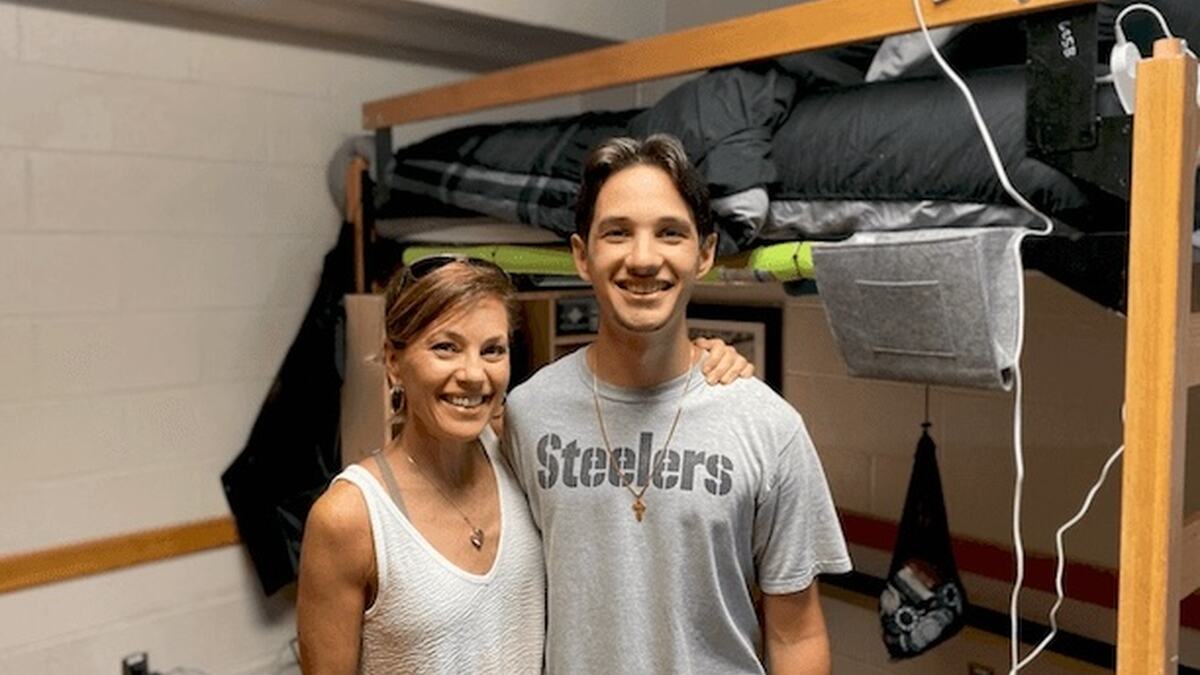
Angela Gala, Cole Gala. Virginia Tech circa 2020.
They passed like ships in the night. In December 2019, the very first headlines of a strange virus originating in Wuhan China was coinciding with her husband’s final bow from a long and courageous battle with cancer.
Though his death presaged the early hours of Covid-19, then little more than faint news alerts from faraway places, she realized in the week's preceding his passing that facing a crisis or summoning courage wasn't quite enough. The moment would require Taking Courage — enlightening and inspiring someone else — to be equal to the task.
The riggers of work, society, and education are still adjusting to an ever changing world. “If you're worrying something will happen—don’t let it,” he said, and in the indomitable spirit of motherhood she accepted the child was gone; released him into the new world; and was proud somehow to simply endow the world her son now serves.

All the World’s a Stage
Make sense of the week's news.
Charlatan reviews the worldview.
CHARLATAN
The Exposé of Politics & Style